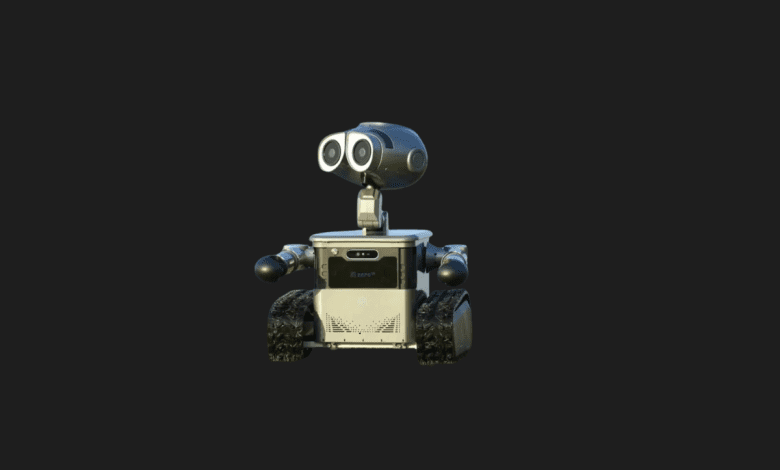

I have a confession to make: I cried during the movie WALL-E. There was something about that rusty, lonely little trash compactor looking for love among the stars that hit me right in the feels. Since 2008, I—and probably half of the tech world—have been secretly waiting for the day we could actually have one of our own.
Well, grab your fire extinguishers (for the excitement, not the robot), because CES 2026 is about to make that dream a reality.
Zeroth Robotics has just unveiled the W1, and let’s not beat around the bush: it is WALL-E. It’s not just a toy; it’s a fully autonomous, heavy-lifting, LiDAR-equipped companion that is entering the US market to change how we look at home robotics.
I dug into the specs, the price, and the features. Here is everything you need to know about the robot that might just steal your heart (and your wallet).
Not Just a Toy: A Heavy Lifter

When I first saw the photos, I assumed the W1 was just another plastic desktop gadget. I was wrong. This thing is a tank.
The W1 weighs in at 28 kilograms (61 lbs), but here is the kicker: it can carry a payload of 50 kilograms (110 lbs).
Think about that for a second. This isn’t just for passing the butter at the dinner table.
- In the garden: It can haul bags of soil or heavy pots.
- In the garage: It can move toolboxes.
- On a trip: It can carry the cooler and the camping gear.
Zeroth Robotics designed this for both home and “light commercial” use. It’s a workhorse disguised as a cartoon character. I love this approach because, for years, home robots were either useless toys or scary industrial dogs. Finally, we have something in the middle.
The Eyes Have It: Personality & Interaction

The reason we loved WALL-E wasn’t because he compressed trash; it was because of his eyes. Zeroth understands this.
The W1 features a head mounted on a movable neck that can nod, look around, and—crucially—move its “eyebrows” to show emotion.
- The Vision System: It has a 2MP RGB camera for tracking and navigation, and a higher resolution 13MP camera for snapping photos.
- The Hands: It has small, functional hands capable of gripping light objects (like a flower, in true Pixar fashion) or tools.
My Take: I’ve tested a lot of “social robots” that feel creepy because they stare blankly. By adding eyebrows and neck articulation, Zeroth is bridging the “uncanny valley.” When this robot looks at you, it feels like it’s looking at you, not just scanning your biometric data.
Under the Hood: The Tech Specs

Okay, let’s geek out for a minute. What powers this little guy?
It’s running on an 8-core Horizon Sunrise Series processor. For those who don’t follow chip architecture, this is designed for high-efficiency edge AI processing. It means the robot can process visual data locally without constantly needing to ping a cloud server (a huge win for privacy).
The Specs at a Glance:
- Memory: 8 GB RAM
- Storage: 32 GB Internal
- Connectivity: Wi-Fi 6, Bluetooth 5.2, 4G LTE, and GPS.
- Battery: 308 Wh capacity.
Battery Life & Charging
It charges fast—0 to 100% in about an hour via 100W DC fast charging. On standby, it lasts about 20 hours. But here is the feature I absolutely love: The W1 is also a walking power bank. It has USB-C ports that can output 60W to 120W. You can literally plug your laptop or phone into your robot friend while you are working in the backyard. That is the kind of practical utility I want to see in 2026.

We’ve all seen the videos of early robots tumbling off edges. To prevent the W1 from becoming a pile of expensive scrap metal, Zeroth loaded it with LiDAR.
It maps its environment in real-time. Whether it’s navigating tall grass in the yard, gravel driveways, or cluttered living rooms, it plans its path dynamically.
- Top Speed: 3.5 km/h on flat ground (a brisk walking pace).
- Slope Speed: 1.8 km/h on inclines.
It creates a 3D map of your home, recognizes distinct objects, and avoids obstacles. It’s basically self-driving car tech shrunk down into a cute chassis.
The “Friendship” Factor
This is where it gets sci-fi. The W1 uses Natural Language Processing (NLP) to converse with you. It recognizes faces, silhouettes, and even hand gestures.
They even market it as a companion for kids—it can supposedly track a ball and “play soccer.” I haven’t seen this in action yet, but the idea of a robot goalkeeper in the backyard is pretty hilarious.
Note: Zeroth Robotics actually developed a special version inspired specifically by Disney/Pixar designs. They aren’t hiding the inspiration; they are leaning into it.
The Price Tag: The Reality Check
And now, we have to return to Earth.
The Zeroth W1 comes with a price tag of $5,599. Pre-orders are open on their site, with shipping expected around April 15, 2026.
Is it worth it? That is the price of a decent used car. For the average person, absolutely not. It’s a luxury item. But for the tech enthusiast, the early adopter, or the person who simply wants a piece of the future roaming their hallway? It might just be irresistible.
We are seeing a shift here. Robots are moving from “utilitarian vacuums” (like Roomba) to “emotional companions.” The W1 is expensive, yes, but it’s trying to be a member of the family, not just an appliance.
Final Thoughts
I’m genuinely excited about the W1. Not because I need help carrying 50kg of groceries, but because it represents a design philosophy I’ve been craving: Technology that feels warm.
For too long, robots have been cold, white plastic blobs. The W1 has character. It has grit. It looks like it belongs in a garage, not a sterile lab.
I want to ask you: If you had $5,600 burning a hole in your pocket, would you buy a robot companion like this? Or do you think we are getting a little too close to replacing human interaction with machines?
Let me know in the comments below!
You Might Also Like;